
Prepare Exhibits
Exhibits are the items you want to show the judge in your hearing or trial to prove your case. Some examples are bank statements or printed copies of text messages. You need to prepare your exhibits before your hearing or trial and give the other side a copy of them. This is called exchanging exhibits. Exchanging exhibits helps you each think about objections or comments you have about the other side’s exhibits. Read more about exhibits in Alaska Civil Rule 43.1.
View video: How Do I Choose and Prepare Exhibits? 
This page tells you how to prepare paper exhibits. Before your hearing or trial, ask your judge at a hearing or by motion what to do if:
- you want to use audio or video recordings evidence,
- your hearing is going to be by Zoom or telephone, or
- you are going to have an informal hearing or trial, which have easier rules for presenting evidence.
- Check the deadline: The judge will give you an order, sometimes called a Pre-Trial Order, that tells you the deadline for exchanging exhibits with the other side. You can talk to the other side about how you want to exchange exhibits. For example, hand delivery, mail, e-mail.
-
Choose your exhibits: Review your papers, pictures, receipts, emails etc..., and anything else you think is important. Every exhibit should help show the judge your side of the story. Your exhibits should be:
- Relevant
- Necessary
- Helpful
- Allowed under the Rules of Evidence
- Put your exhibits in order: You do not have to present your exhibits in order, but it is easier if they are in an order that makes sense to you so you can find things easily.
-
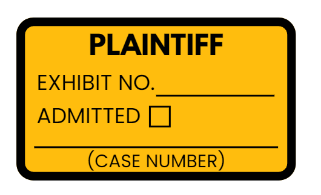
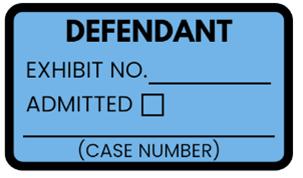
Stickers: All of your exhibits must be labeled with special stickers.
-
Plaintiffs use the yellow stickers and label the exhibits using numbers: 1, 2, 3, etc.
-
Defendants use the blue stickers and label the exhibits using letters: A, B, C, etc.
- You can get these free stickers from your local court or by calling the Family Law Self-Help Center at (907) 264-0851. You can also buy them online or at an office supply store.
- Put an exhibit sticker on the bottom right corner of the first page of each exhibit. If the sticker would cover up something in the lower right-hand corner, put it as close to the corner as you can without covering up important information.
- Write your case number and the exhibit number or letter on each sticker.
- If the exhibit has a lot of pages, write the page number on each page. For example, Exhibit B, page 3. You only need a sticker on the first page.
-
Plaintiffs use the yellow stickers and label the exhibits using numbers: 1, 2, 3, etc.
- Fill out your “Exhibit List”: Fill out the top section of the Exhibit List, TF-200. Write your exhibit number and a short description of your exhibit in the first two columns. The court will fill out the rest.
-
Create Exhibit Packet & Copy: The first page should be you Exhibit List, followed by your exhibits in order (example: 1, 2, 3 or A, B, C). Make 4 copies of everything.
- Bring the original to court to introduce during your hearing or trial.
- Give 1 copy to the other side by the deadline.
- 1 copy is for you. You can use it to prepare and can write on it if you want. It helps if you put your exhibits in a binder. Bring your copy to court.
- 1 copy is for the judge to look at during your hearing or trial. Bring it to court and give it to the judge or clerk before your hearing or trial starts.
- 1 copy is for witnesses if needed.
- Note: unless the judge asks for exhibits ahead of time, bring them to court with you.
- Learn how to introduce exhibits: The Judge does not look at or consider your exhibit unless they are "admitted" into evidence during your hearing or trial. Learn about how to admit your exhibits.
- Questions? Learn more about getting ready for a trial or hearing or call the Family Law Self-Help Center at (907) 264-0851.